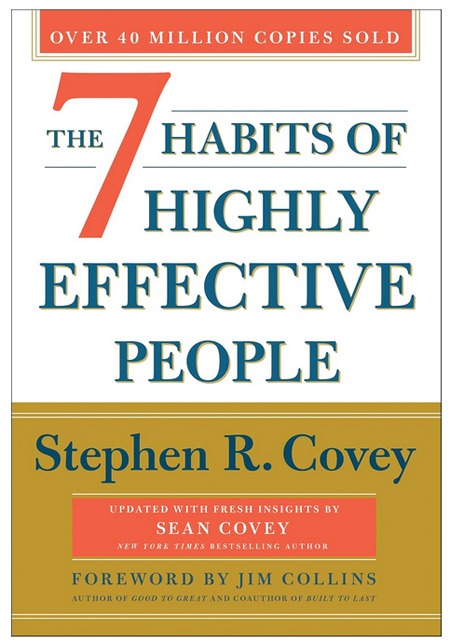
This article contains summarized notes that I have written for each chapter of Stephen Covey’s book “The 7 Habits of Highly Effective People.”
Note that this article is not a substitute for reading the actual book, but it is useful to periodically read it in order to help keep what was spoken about fresh in your mind.
I have emphasized the text in order to help increase the speed and effectiveness of reviewing it.
Part One: PARADIGMS AND PRINCIPLES
Chapter: INSIDE OUT
In order to have “PRIMARY GREATNESS,” you must accurately understand the way things ACTUALLY ARE with you, and the ways things SHOULD BE with you.
The HEALTHY PRINCIPLES of FAIRNESS, INTEGRITY and HONESTY, HUMAN DIGNITY, SERVICE, QUALITY and EXCELLENCE, POTENTIAL, GROWTH, PATIENCE, NURTURANCE, and ENCOURAGEMENT are universal to everyone, and they are key to being a good person.
THE INSIDE-OUT APPROACH is to have PRIVATE victories precede PUBLIC victories, where making and keeping promises to ourselves precedes making promises to others.
The principle of FAIRNESS: Equality, respect, and justice in relationships, ensuring that all parties involved are treated justly and have equal opportunities.
The principles of INTEGRITY and HONESTY: Integrity involves having strong moral principles and consistently adhering to them, while honesty is the act of being truthful and free from deceit.
The principle of HUMAN DIGNITY: Every person has worth and deserves respect and ethical treatment.
The principle of SERVICE: Emphasizes the importance of serving and helping others with a focus on their needs, where the service is genuine and not driven by ulterior motives.
The principles of QUALITY and EXCELLENCE: Quality refers to the ability of a product or service to meet established standards and customer expectations, emphasizing consistency and reliability. Excellence is a broader concept that focuses on achieving outstanding performance and continuous improvement, driven by motivation rather than just meeting external standards.
The principle of POTENTIAL: Considering and nurturing the best possible version of someone, rather than judging them based on their current circumstances or actions.
The principle of GROWTH: We should treat others as we wish to be treated.
The principle of PATIENCE: Tolerating delays, discomfort, or frustration without losing composure.
The principle of NURTURANCE: Caring for and supporting others, helping them grow and develop emotionally and socially.
The principle of ENCOURAGEMENT: Building one another up through positive words and actions, creating a supportive environment.
___
Chapter: THE SEVEN HABITS— AN OVERVIEW
The Seven Habits are HABITS OF EFFECTIVENESS based on HEALTHY PRINCIPLES. Effective HABITS of INTERNALIZED PRINCIPLES and PATTERNS OF BEHAVIOR are the intersection of KNOWLEDGE, SKILL, and DESIRE.
KNOWLEDGE is “WHAT to do and why,” SKILL is “HOW to do it,” and DESIRE is “the MOTIVATION and want to do it.” You must work in all three dimensions in order to create an effective habit.
An important concept is a principle called the “P/PC Balance,” which is a paradigm of effectiveness based on a natural law of finding a crucial BALANCE OF FOCUS between WHAT is Produced (Product) and the CAPACITY to Produce (Production Capacity). An example would be the fable of the goose that laid golden eggs, with the eggs being the product, and the goose being the production capacity. True effectiveness is a function of a BALANCE of maintaining BOTH aspects.
The “P/PC” concept applies EVERYWHERE, such as with PHYSICAL ASSETS like a lawnmower that requires upkeep, PERSONAL FINANCIAL ASSETS such as utilizing loans and earning power, and PERSONAL RELATIONSHIPS requiring give and take such as in marriages. In ORGANIZATIONS it applies to PHYSICAL ASSETS such as making sure to maintain the equipment, and HUMAN ASSETS such as always treating your employees as well as you want them to treat your best customers.
___
Part Two: PRIVATE VICTORY
Chapter: HABIT 1— BE PROACTIVE — Principles of Personal VISION (Properly recognize what you actually have power to do and not do.)
REACTIVE people are overly affected by circumstances in their environment, whereas PROACTIVE people take responsibility of their own lives and don’t blame circumstances, conditions, or conditioning for their behavior, and they also take initiative by recognizing their responsibility to make things happen.
Some of the things within your CIRCLE OF CONCERN you HAVE control over, and the rest you DO NOT have control over. You should visualize a circle within your Circle of Concern called the “Circle of INFLUENCE” which represents the aspects that you do have control over. By determining which of the two circles is the focus of most of your time and energy, you can discover much about the degree of your PROACTIVITY. Your focus is only effective if it is in your CIRCLE OF INFLUENCE.
The problems you face fall into one of three areas: 1. DIRECT CONTROL (problems involving your OWN behavior); 2. INDIRECT CONTROL (problems involving OTHER PEOPLE’S behaviors); or 3. NO CONTROL (problems you can do nothing about, such as your past or situational realities). A PROACTIVE approach puts the first step in the solution to all three kinds of problems within your present CIRCLE OF INFLUENCE.
At the heart of your CIRCLE OF INFLUENCE is your ability to make and keep COMMITMENTS and PROMISES to yourself and others, which is the essence of developing the basic HABITS OF EFFECTIVENESS.
___
Chapter: HABIT 2— BEGIN WITH THE END IN MIND — Principles of Personal LEADERSHIP (Properly PLAN what you must do.)
All things are created TWICE. There’s the MENTAL or first creation, and the PHYSICAL or second creation. HABIT 2 is based on principles of PERSONAL LEADERSHIP, which is the FIRST creation. Leadership is not MANAGEMENT which is the SECOND creation that will be discussed in the next chapter. LEADERSHIP is about making sure to be “doing the RIGHT things,” whereas MANAGEMENT is “doing those things properly.”
The most fundamental aspect of HABIT 2 is to “begin with the end in mind” with all aspects of your life.
Whatever is at the center of your life will be the source of your SECURITY, GUIDANCE, WISDOM, and POWER, which are INTERDEPENDENT with each other. You can have much conscious control over your aspects of GUIDANCE and POWER.
SECURITY is your sense of worth or self-esteem.
GUIDANCE is your source of direction in life, your STANDARDS and PRINCIPLES.
WISDOM is your perspective on life.
POWER is your facility of the capacity to act, the STRENGTH and POTENCY to accomplish something, including your capacity to overcome embedded bad habits and to cultivate higher, more effective ones.
When those four factors are present together, harmonized and enlivened by each other, they create a great force of a noble personality, a balanced character, a beautifully integrated individual.
PRINCIPLES are fundamental truths that are universal to everyone and are tightly interwoven through the fabric of life.
The ideal is to create ONE CLEAR CENTER from which you consistently derive a high degree of SECURITY, GUIDANCE, WISDOM, and POWER, empowering your proactivity and giving congruency and harmony to every part of your life (a center based on HEALTHY PRINCIPLES.)
___
Chapter: HABIT 3— PUT FIRST THINGS FIRST — Principles of Personal MANAGEMENT (Effectively IMPLEMENT your plans.)
HABIT 3 is the personal fruit, THE PRACTICAL FULFILLMENT OF HABITS 1 AND 2 THROUGH PRACTICING EFFECTIVE SELF-MANAGEMENT.
HABIT 1 says “YOU’RE the programmer,” HABIT 2 says “WRITE the program,” and HABIT 3 says “Run the program, live the program.” LIVING IT is primarily a function of your INDEPENDENT WILL, SELF-DISCIPLINE, INTEGRITY, and COMMITMENT.
THE SUCCESSFUL PERSON HAS THE HABIT OF DOING THINGS THAT FAILURES DON’T LIKE TO DO. They don’t necessarily like doing them either, but their disliking of it is subordinated to the strength of their purpose.
PEOPLE CAN SPEND THEIR TIME FOUR DIFFERENT WAYS — QUADRANT I: “Urgent and Important” activities (The Zone of DEMAND); QUADRANT II: “Not Urgent but Important” activities (The Zone of FULFILLMENT); QUADRANT III: “Seemingly ‘urgent’, but not actually important” activities (The SHALLOW, SUPERFICIAL zone, the zone of DELUSION); and QUADRANT IV: “Not Urgent and Not Important” activities (The Zone of DISTRACTION).
QUADRANT I is dealing with tasks that are genuinely a CRISIS or PROBLEM that require your immediate attention. Aspects of someone living too much of their life in QUADRANT I include: Being constantly stressed and burned out; Always needing to be putting out fires through crisis management.
QUADRANT II (Things that are not urgent but are important — The Zone of FULFILLMENT) is the most ideal focus of your personal management. It is dealing with things like building relationships, performing long-range planning and preparation, exercising your body, and performing preventative maintenance— all of the things that you need to do, but can be neglected because they aren’t “urgent.” Aspects of living your life primarily in QUADRANT II include: Having VISION and PERSPECTIVE; Having BALANCE; Having DISCIPLINE; Having CONTROL; Thus needing to deal with crisis much less frequently.
Aspects of someone living too much of their life in QUADRANT III (“Seemingly ‘urgent’, but not actually important”— The SHALLOW, SUPERFICIAL zone, the zone of DELUSION) include: Having a short-term focus; Often finding themself needing to do crisis management; Being obsessed with manipulating their reputation through behaving with a chameleon character; Seeing goals and plans as worthless; Feeling victimized; Feeling out of control; Having shallow or broken friendships.
Aspects of someone living their life too much in QUADRANT IV (“NOT urgent and NOT important” — The Zone of DISTRACTION) include: Being totally irresponsible; Being fired from jobs; Being dependent on others or institutions for the basics in their life.
Most people say that their main fault is LACK OF DISCIPLINE, but more likely it is their LACK OF PRIORITIES implanted in their hearts and minds. If your priorities grow out of a PRINCIPLE center, a personal mission which is deeply planted in your heart and mind, you will then see QUADRANT II (“Not urgent but important” activities— the zone of FULFILLMENT) as a natural and exciting place to invest your time. If you don’t have a bigger “yes” burning inside, it will be almost impossible to say “no” to Quadrant III or to the pleasure of escape to Quadrant IV.
You accomplish all that you do through DELEGATION— either to your time or to other people. When you delegate to your TIME, you should think “efficiency,” and when you delegate to OTHER PEOPLE, you should think “effectiveness.”
___
Part Three: PUBLIC VICTORY
Chapter: PARADIGMS OF INTERDEPENDENCE (Treat others well with genuinely healthy motivations.)
Before moving into the area of “Public Victory,” it is important to realize that effective INTERdependence can only be built on a foundation of true INdependence. A PRIVATE VICTORY must precede a PUBLIC VICTORY.
You have to like yourself before you can like others. Self-respect comes from dominion over your SELF, from true independence— which is the focus of Habits 1, 2, and 3.
The most important ingredient that we put into any relationship is not what we say or do, but who we are.
The EMOTIONAL BANK ACCOUNT is a metaphor that describes the amount of trust that has been built into a relationship, it is the feeling of safeness you have with another person. You make deposits into an emotional bank account with somebody through your courtesy, kindness, honesty, and keeping your commitments. This builds a subconscious reserve of trust which you likely will be able to call upon if you need it.
THE SIX MAJOR DEPOSITS— There are six major deposits that build your emotional bank account with others: 1. Understanding the individual; 2. Attending to the little things; 3. Keeping commitments; 4. Clarifying expectations; 5. Showing personal integrity; and 6. Apologizing sincerely when you make a withdrawal.
___
Chapter: HABIT 4— THINK WIN / WIN — Principles of INTERPERSONAL LEADERSHIP (It is healthy to seek mutual benefit in your interactions with others.)
“WIN / WIN” is not a technique, it is a total philosophy of human interaction— It is one of six potential paradigms of interactions which are “WIN / WIN”, “WIN / LOSE”, “LOSE / WIN”, “LOSE / LOSE”, “WIN”, and “WIN / WIN OR NO DEAL.”
WIN / WIN is a frame of mind that constantly seeks MUTUAL BENEFIT in human interactions. There are three character traits essential to the WIN / WIN Paradigm: INTEGRITY, MATURITY, and ABUNDANCE MENTALITY.
WIN / LOSE is a paradigm of COMPETITION— such as managers being put in a race to win a trip to Bermuda.
LOSE / WIN is a paradigm of somebody having the mentality of a doormat.
LOSE / LOSE is what happens when two WIN / LOSE people interact— both will lose.
WIN is a mentality where it only matters to a person that they get what they want.
WIN / WIN OR NO DEAL is a paradigm where if both parties can’t find a solution that would benefit them both, they agree to disagree agreeably and don’t make a deal.
___
Chapter: HABIT 5— SEEK FIRST TO UNDERSTAND, THEN TO BE UNDERSTOOD — Principles of Empathic Communication (Genuinely listen to and consider what others have to say.)
The single most important principle in the field of interpersonal relations is “Seek first to understand, then to be understood.”
There are five levels of LISTENING listed by the amount of effectiveness: IGNORING, PRETENDING TO LISTEN, SELECTIVE LISTENING, ATTENTIVE LISTENING, and EMPATHIC LISTENING. EMPATHIC LISTENING is listening to UNDERSTAND rather than only to reply.
A key way to subconsciously show the listener that you are EMPATHETICALLY LISTENING to them is by REPHRASING THE CONTENT AND REFLECTING THE FEELING.
MATURITY means a balance between COURAGE and CONSIDERATION— Seeking to UNDERSTAND requires CONSIDERATION— seeking to BE UNDERSTOOD requires COURAGE. WIN / WIN requires a high degree of both.
When you present your ideas clearly, specifically, visually, and most important, contextually— in the context of deep understanding of your audience’s paradigms and concerns— you significantly increase the credibility of your ideas.
___
Part Four: RENEWAL
Chapter: HABIT 7— SHARPEN THE SAW — Principles of Balanced Renewal (Take time to develop the PRODUCTION CAPACITY in all areas of your life.)
Covey explains an example of a woodcutter working for hours trying to cut down a tree, being exhausted doing it, but not stopping to sharpen his saw for a few minutes because it would distract him from his work, even though sharpening the saw would dramatically speed up his job.
Habit 7 is similar to the woodcutter sharpening his saw— it surrounds all of the other habits on the Seven Habits paradigm because it is the habit that makes them possible.
An important concept is a principle called the “P/PC Balance,” which is a paradigm of effectiveness based on a natural law of finding a crucial BALANCE OF FOCUS between WHAT is Produced (Product) and the CAPACITY to Produce (Production Capacity). An example would be the fable of the goose that laid golden eggs, with the eggs being the product, and the goose being the production capacity. True effectiveness is a function of a BALANCE of maintaining BOTH aspects.
Habit 7 is personal P/C— Preserving and enhancing the greatest asset you have— you. It is RENEWING the four dimensions of your nature— PHYSICAL, SPIRITUAL, MENTAL, and SOCIAL / EMOTIONAL. The renewal is optimally effective when all four are dealt with in a wise and balanced way, where neglecting one area negatively impacts the rest.
The PHYSICAL dimension involves effectively taking care your physical body— eating the right kind of food, getting sufficient rest and relaxation, and exercising on a regular basis.
RENEWAL is the principle and the process that empowers your to move on an upward spiral of growth and change, of continuous improvement.
To keep progressing, you must LEARN, COMMIT, and DO— and then LEARN, COMMIT, and DO again.
___
Chapter: INSIDE-OUT AGAIN (Real change can only come from breaking out of your previous habits and paradigms.)
Real change comes from the inside out— it only comes from striking the root— the fabric of your thought, your fundamental, essential paradigms which give definition to your character and create the lens through which you see the world.
Building a character of total integrity and living a life of love and service that creates such unity is possible if IT BEGINS WITH YOUR DESIRE TO CENTER YOUR LIFE ON CORRECT PRINCIPLES, AND TO BREAK OUT OF THE PARADIGMS CREATED BY OTHER CENTERS AND COMFORT ZONES OF UNWORTHY HABITS.
IF YOU START WITH YOUR DAILY PRIVATE VICTORIES AND WORK FROM THE INSIDE OUT, THE RESULTS WILL SURELY COME. As you plant the seed and patiently weed and nourish it, you begin to feel the excitement of real growth and eventually taste the fruits of having a congruent and effective life.
By centering your life on CORRECT PRINCIPLES and creating a balanced focus between DOING and INCREASING YOUR ABILITY TO DO, you become empowered in the task of creating an effective, useful, and peaceful life.