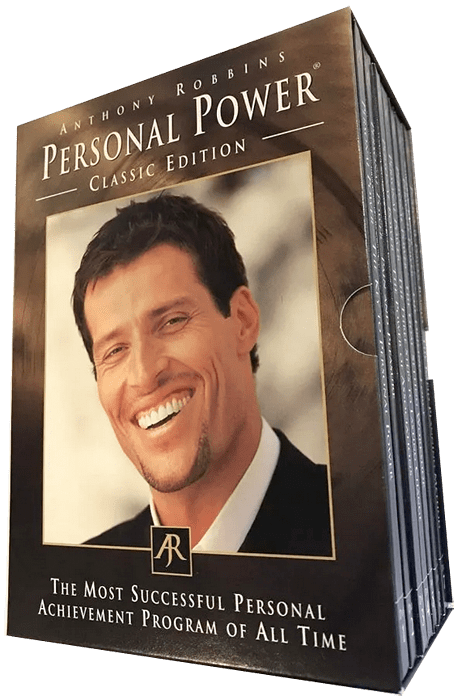
This article contains summarized notes that I have written for each CD in Tony Robbins’ “Personal Power” program (link) which I first listened to about 25 years ago. Note that this article is not a substitute for listening to the actual program, but it is useful to periodically read it in order to help keep what was spoken about fresh in your mind.
I have emphasized the text of the article in order to increase the speed and effectiveness of reviewing it. I have put a spacer between the summarized information for each chapter, each of which is explained in detail on its own audio CD. Each of the CDs in the program is between 30 minutes and 1 hour in length.
Power is the ability to act.
The four steps to success: 1. Know the outcome you want; 2. Take action; 3. Notice what is happening; and 4. Modify your approach as necessary until you succeed.
Forces which act like GRAVITY are counteracted when you apply your energy.
___
The motivating forces of human nature are to AVOID PAIN and SEEK PLEASURE. YOU MUST USE PAIN AND PLEASURE TO YOUR ADVANTAGE by controlling your focus and changing subconscious associations— otherwise pain and pleasure will use you .
At every moment, WHATEVER YOU FOCUS YOUR ATTENTION ON IS WHAT IS MOST REAL TO YOU. Therefore, IF YOU WANT TO CHANGE YOUR BEHAVIOR, you must take control of what you FOCUS on.
PROCRASTINATION IS THE SILENT KILLER. You should link not taking action to PAIN.
For every disciplined effort there is a multiple reward.
____
What controls your life are the “meanings” that you associate to situations.
“Neuroassociations” are the pain or pleasure that you subconsciously associate or “link” with situations that ultimately control your behavior. In order to change your life, you must reprogram your neuroassociations.
YOUR DESTINY IN LIFE HAS FOUR PARTS: 1. Everything you THINK or DO is a cause set in motion (positive or negative); 2. Every one of your thoughts and actions is going to have an EFFECT or RESULT in your life; 3. Your results begin to “stack up” to take your life in a particular DIRECTION; 4. For every direction there is an ultimate DESTINATION or DESTINY.
Your behavior will not change until you condition yourself to feel differently.
___
NEUROASSOCIATIVE CONDITIONING (NAC) is the science of controlling your behaviors through changing your subconscious associations with pain and pleasure. The three fundamentals of NAC are 1. GETTING LEVERAGE— Recognizing a REASON to change; 2. INTERRUPTING THE ASSOCIATION— Such as creating an unexpected jolt of some kind for you to experience; and 3. CONDITIONING A NEW EMPOWERING ASSOCIATION, AND REINFORCING IT WITH REPETITION.
____
Everything that humans do is simply an attempt to change the way they feel— to “change state.” At every moment, what you do is powerfully shaped by the STATE you are in. One of the most important things you can do to create power, joy, and happiness in your life is to learn to manage your states of mind, which can be accomplished using PHYSIOLOGY (Physical methods such as moving your body, breathing, and diet) as well as by CONTROLLING YOUR MENTAL FOCUS.
___
Using your MENTAL FOCUS, you can control WHAT you are picturing in your mind and HOW you are picturing it, which immediately changes your state.
At every moment, HOW YOU EVALUATE THINGS (the questions that you subconsciously ask yourself) determines WHAT YOU ARE FOCUSING ON, which then determines your STATE— which then ultimately determines THE CIRCUMSTANCES OF YOUR LIFE. Therefore the quality of your life is ultimately contingent upon THE QUALITY OF THE QUESTIONS THAT YOU ASK YOURSELF.
____
Your VALUES and BELIEFS are two forces that work together to consciously and unconsciously control your decisions that control the direction of your life.
VALUES are emotional states that, based on life experience, you believe are the most important for you to experience (move toward) or avoid (move away from).
Examples of “moving towards” values (pleasure values) are love, success, attraction, power, adventure, happiness, and security.
Examples of “moving away from” values (what you want to avoid) and frustration, anger, depression, and physical pain.
It is important to make the distinction between ENDS VALUES, which are emotions that drive all of our behaviors, and MEANS VALUES which are simply “vehicles” or “instruments” to achieve the ends values.
“Means” values are for getting to a change state, for example a person wanting to have a family is a means to arrive at an emotion that they get out of it, or the STATE. “Ends” values are the feelings and emotions you will have when getting to the change state.
The key in life is to know what you are really after. All decision making is nothing but VALUES CLARIFICATION— If you know what you value most, what you truly want most out of life, then you will find that you can make decisions much more effectively and rapidly.
A BELIEF is a feeling of certainty about the meaning of something. Your beliefs determine whether or not you feel like you are meeting your values— and they can either limit you or liberate you.
Your BELIEFS have been subconsciously entrenched within you throughout your life through your experiences, and they can be either empowering to you or disempowering.
There are two basic kinds of beliefs. 1. GLOBAL beliefs are generalizations: “Life is…”, “People are…”, “I am…”; 2. And CONDITIONAL beliefs are rules: “If this, then that.”
Unhealthy LIMITING BELIEFS shut you down and immediately chain you to limitations.
What you focus on is based on your VALUES.
FOR ANY CIRCUMSTANCE, YOUR BRAIN FIRST EVALUATES THE EXPERIENCE. First it looks at what VALUES are important in your life. Then it looks at NEUROASSOCIATIONS. For example: If someone values adventure, they would be drawn toward skydiving; or if someone values security, they would not be as drawn to skydiving.
If you know someone’s values, you can predict the overall direction of their life. If you would swap values in a person, it would completely change their personality and life.
If you take conscious control to change and optimize your VALUES and BELIEFS, you change your DESTINY, because you change what you are focusing on daily— creating a whole new set of CAUSES and EFFECTS.
Before improving your values, you need to find out what they currently are. If you have a list of your values, you know what you are focused on.
___
You can use NEUROASSOCIATIVE CONDITIONING (NAC) to help to change your BELIEFS.
___
You must set goals to move toward, and the PURPOSE of your goals is much more important than the planned outcome. Setting a goal acknowledges to your conscious and subconscious mind that where you are is not where you want to be. Whatever you focus on is what is real. You can use pressure and dissatisfaction to your advantage.
___
People are not lazy, they just have impotent goals. You must intensely visualize your goals to the point that you feel as if you have already achieved them.
___
Your consistent EMOTIONS shape your character and destiny. If you are feeling any EMOTION on a consistent basis, it is the result of an internal RITUAL. Your RITUALS consist of your habitual ways of looking at the world, thinking to yourself, and moving your body. RITUALS are subconsciously fired off by stimulus from your environment (ANCHORS.)
Procrastination is nothing but a ritual. The easiest ways to deal with procrastinating is to “put it off” until later (“procrastinate the procrastinating”), and to condition yourself to know that not following through is more painful than following through.
___
Whenever you are in an intense emotional state, anything that consistently happens around you while you’re in the peak of that state gets associated with it. This process is called ANCHORING.
An example is hearing a particular song reminding you of a person or place from the past, where it is because you were hearing the song when you were in a peak emotional state.
The behavior of Pavlov’s dogs drooling when they hear a bell that is rung before being given food is another example of anchoring.
You can consciously ENTRENCH POSITIVE ANCHORS and COLLAPSE NEGATIVE ONES.
___
If you do not have enough money, it is likely because you have not conditioned yourself for wealth. People often have seven “wealth wounds” which are unhealthy assumptions about money that cause people to cripple themselves financially.
___
Sometimes people subconsciously associate pleasure with not having financial abundance, or they are frightened by the thought of having more money because it is “the unknown”— and thus they sabotage their ability to make money. Their finances will not improve until they change their core beliefs about money and subconsciously link pain to not having it, as well as learning how to counter the “seven wealth wounds.”
___
Fear is an emotional state where your brain is activated to protect yourself in anticipation of pain. People are often afraid of failure because they set themselves up with impossible rules for success, and they can eliminate such fear by realizing that nobody outside of themselves can label themselves as a failure. Fear can also be eliminated by reprogramming neuroassociations associated with it.
___
Self-sabotage is stopping yourself from following through to avoid pain of some sort. Such fear-based behavior can be reprogrammed by “interrupting the pattern” using “the erasure technique.”
Self-confidence can be enhanced through physiology (PHYSICAL factors), controlling your mental focus, and improving your core beliefs which create positive momentum of the success cycle.
The SUCCESS CYCLE is an important visualization of a circular chain of processes which RESULTS IN THE POSITIVE OR NEGATIVE QUALITY OF YOUR LIFE, as follows:
BELIEFS (influence —>) POTENTIAL (influencing —>) ACTIONS (influencing —>) RESULTS [often including EXPERIENCES] (which then loop around to influence BELIEFS again —>)
____
Two things you can do immediately to improve your physical health are to understand the power of breathing and to eat water-rich foods such as fruits and vegetables.
___
Common challenges to relationships include people thinking of it as “the solution to their problems” and only taking from the relationship rather than giving, lack of spontaneity in the relationship, negative anchors being established in the relationship, and partners failing to meet each other’s needs.
___
The key to problem solving: 1. Control your focus; 2. Expect an answer; 3. Know what you want, try something, and notice if it is working; 4. Then change your approach if necessary.
___
Common life paths of people are “The Dabbler”, “The Stresser”, and “The Master”. It is “The Master” who finds true fulfillment in life by practicing the fundamentals that are taught in this program every day, and continuing to keep going when they hit a plateau. Remember the key ideas: 1. Decide what you really want; 2. Develop a plan; 3. Take action; 4. Be flexible.
___
You can develop habits that stick with you by understanding how to ESTABLISH POSITIVE SUBCONSCIOUS ANCHORS, TAKE ADVANTAGE OF EXISTING POSITIVE ANCHORS and ELIMINATING NEGATIVE ONES— by reprogramming your anchors using the SWISH pattern method.
Something you can do immediately to improve your physical and mental health is to understand the power of BREATHING.
____
There are four “CLASSES” of experiences:
A Class 1 experience is something that: Feels good, is good for you, is good for others, and serves the greater good. <— When these criteria exist, it is a “peak life experience.”
A Class 2 experience is something that: Does NOT feel good, but is good for you, is good for others, and serves the greater good. <— These are experiences that you often want to avoid but ultimately give you joy because they cause you to grow as a human being, and as you master them you become more fulfilled.
A secret to being fulfilled is learning how to convert Class 2 experiences into Class 1 experiences.
A Class 3 experience is something that: Feels good, is NOT good for you, is NOT good for others, and does NOT serve the greater good. <— These are non-productive experiences that are indulged in too much, for example drinking too much alcohol, etc. These experiences provide people with immediate pleasure but in the long term give them pain.
A Class 4 experience is something that: Does NOT feel good, is NOT good for you, is NOT good for others, and does NOT serve the greater good. <— Starting smoking cigarettes for the first time is an example. People often engage in these experiences out of peer pressure, conditioning, or old belief systems.
All people have SIX BASIC NEEDS which can initially seem to be paradoxical, i.e. being in conflict with each other. Serious problems can arise if you choose destructive “vehicles” to try to satisfy those needs. But also you can choose to establish new patterns of fulfilling those needs that will move you rapidly toward life mastery.
1. Certainty / Comfort
2. Uncertainty / Variety <— #1 and #2 must be balanced with each other.
3. Significance
4. Connection / Love <— #3 and #4 must be balanced with each other.
5. Growth
6. Contribution <— #5 and #6 must be balanced with each other.